

World Cup Draw Pots and Seeding
Introduction: Understanding World Cup Draw Pots and Seeding
The FIFA World Cup is not just the world’s biggest football tournament it is also a carefully engineered competition shaped heavily by the draw pots and seeding system. Before the first ball is kicked, before fans start dreaming about knockout upsets or fairy-tale runs, every participating nation waits anxiously for the draw. This moment doesn’t just determine matchups; it defines the entire tournament pathway. But what exactly are World Cup draw pots? How does FIFA seed teams? And why does this process matter so much?
In this section, we’ll explore the foundational concepts behind the draw, breaking down the logic, structure, and strategy involved. Understanding the system is essential because it explains why some nations end up with seemingly easier groups while others are thrown into the dreaded “Group of Death.” More importantly, it offers insights into how FIFA ensures competitive balance at least in theory.
Each World Cup cycle introduces slight variations to the draw process, but the core principles remain the same: rankings, regional balance, and competitive integrity. The seeding system exists to prevent all top teams from landing in one group while still allowing for unpredictability and excitement. Think of it as arranging a massive, global tournament bracket where fairness meets chance.
By the end of this article, you’ll not only understand how pots and seeding work you’ll also see how they shape football history itself. The draw sets the stage for glory or heartbreak long before the first whistle, making this one of the most influential parts of the entire World Cup journey.
Why the World Cup Draw Matters
The World Cup draw isn’t just a ceremonial event with shiny balls, celebrity ex-players, and dramatic pauses it’s one of the most influential moments in international football. When teams gather to see which group they land in, they’re essentially watching their entire destiny unfold in real time. A single draw can elevate a nation’s hopes or crush them before the tournament even begins.
That’s because the group you’re placed in determines your path: opponents, match difficulty, travel demands, fatigue risk, and even the psychological expectations of fans and media.
For example, a team placed in a favorable group meaning one with opponents ranked significantly lower immediately gains confidence, media excitement, and a realistic shot at advancing.
On the other hand, landing in a “Group of Death” can put immense pressure on even the biggest footballing nations. It affects their preparation, their tactical plans, and sometimes even the morale inside the camp.
In past tournaments, we’ve seen world-class teams knocked out early simply because they were placed against strong opponents right from the start.
But the draw also matters for smaller nations. For many underdogs, the World Cup is a rare stage, and the group they’re placed in can shape their entire experience. Facing legendary football nations offers exposure, excitement, and learning opportunities, but facing opponents closer to their level gives them a real chance to make history.
It’s one of the few moments where luck and preparation collide.
In terms of global excitement, the World Cup draw also shapes narratives. Rivalries are born, rematches are set, and predictions flood social media. Fans worldwide analyze the pots, compare rankings, and debate which groups are the toughest or most favorable.
The drama begins months before the actual football starts and much of that drama stems from how the pots and seeding are arranged. Without the draw, the World Cup would lose a huge part of its anticipation and storytelling.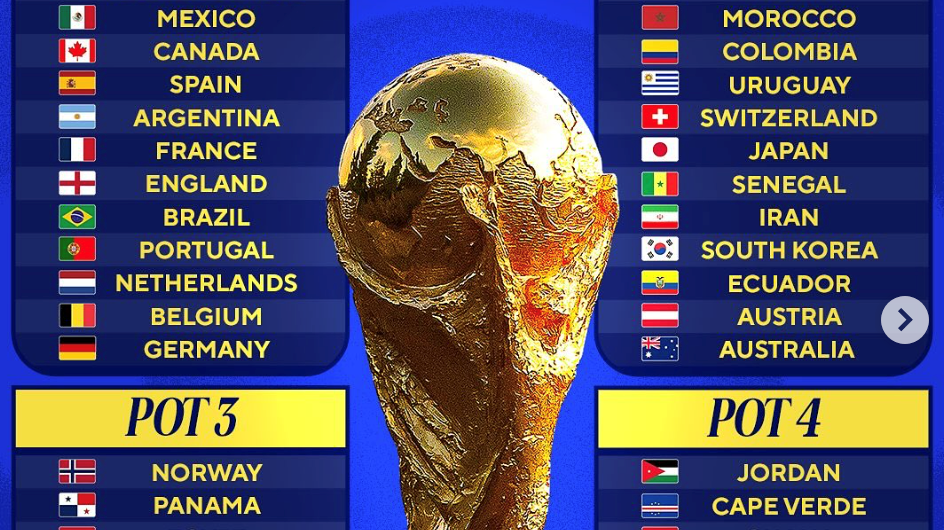
How FIFA Determines Seeding Rankings
Seeding is the backbone of the World Cup draw, and FIFA doesn’t assign it randomly. Instead, it relies heavily on the FIFA World Rankings a mathematical system designed to measure a national team’s performance over time. But while many fans think the rankings are just simple win–loss tallies, they’re actually far more complex.
Each match a team plays is assigned a point value based on the strength of the opponent, the importance of the match, the result, and even the geographical confederation involved. Competitive matches such as World Cup qualifiers or continental tournaments weigh significantly more than friendlies.
FIFA updates these rankings monthly, and the snapshot taken closest to the World Cup draw determines each nation’s placement. This means timing matters. A team might rise sharply with a few strong results before the draw, while a slump at the wrong moment can drop them into a lower pot. The ranking system rewards consistency.
Teams that perform well in high-stakes matches regardless of how “big” or “small” the nation is get an advantage in seeding.
One detail many fans overlook is how strategic teams can be with their friendly matches. Some nations schedule matches against higher-ranked opponents because beating a strong team offers a big boost in points. Others avoid difficult opponents just before the ranking cutoff to avoid losing ground.
It becomes a balancing act of strategy, skill, and timing.
When the rankings are finalized, the top seven nations plus the host country are placed into Pot 1. These are essentially the “seeded teams,” meaning they are protected from facing each other in the group stage.
The remaining pots are filled with teams ranked below them, distributed in order of their FIFA ranking. This method ensures at least some balance in the competition. But even with this system, surprises still occur because confederation restrictions can shuffle pairings in unexpected ways.
In short, FIFA’s seeding process is designed to create fairness but it’s also deeply influenced by how teams plan, perform, and prepare in the months leading up to the tournament. Every goal scored and every match won can literally change a World Cup destiny.
How Teams Are Distributed Into Pots
The distribution of teams into pots is one of the most crucial steps in shaping the World Cup draw, and although it may look simple on the surface, it’s actually a highly organized and strategically designed process. FIFA uses a combination of world rankings, confederation balancing rules, and logistical considerations to create pots that ensure fairness, competitive integrity, and global diversity.
Each World Cup features four pots, each containing eight teams (for the current 32-team format), though this will expand with the 48-team tournament.
The assignment starts with Pot 1, which always includes the host nation this is a long-standing tradition that ensures the home crowd can enjoy their opening matches locally, and it also guarantees the host avoids the toughest teams early. Alongside the host, the top-ranked seven teams in the FIFA rankings are added. These are considered the “seeded” teams.
Because they are distributed across different groups, they are protected from facing each other in the group stage, ensuring balance.
Pot 2, Pot 3, and Pot 4 follow in ranking order. Teams are added based on their world ranking positions at the time of the official cutoff. Pot 2 contains the next eight highest-ranked teams, Pot 3 the next eight, and Pot 4 the lowest-ranked qualifiers plus any intercontinental playoff winners.
This step-by-step system creates a hierarchy that prevents too many strong teams from ending up together in the same group. Yet, because of confederation restrictions such as the rule that no group can contain two teams from the same confederation (except UEFA, which may have two) sometimes the draw directors must adjust on the fly.
This dynamic balancing act is what makes the draw so unpredictable and exciting.
Even though pots are structured logically, the final groups can still produce headline-making outcomes. A Pot 4 team might be significantly stronger than its rank suggests, creating shocking group matchups. In other cases, a Pot 2 team may be just as powerful as a Pot 1 team, leading to debates about fairness.
Fans watch closely because one random moment one ball drawn, one rule applied can completely change a team’s path to the knockout stage.
Overall, the pot distribution process blends mathematics, tradition, and luck, making it one of the most pivotal and fascinating components of the World Cup setup.
Confederation Restrictions and Why They Exist
Confederation restrictions are one of the most misunderstood yet essential parts of the World Cup draw. Many fans think the draw is simply about ranking and geography, but FIFA must also ensure global diversity and competitive balance in the group stage.
Without confederation restrictions, we could easily end up with multiple European teams clustered together or entire groups dominated by South American powerhouses something FIFA actively tries to avoid.
These restrictions guarantee that fans around the world see a wide mix of football cultures and styles in every group.
The rule is straightforward: no group can contain more than one team from the same confederation, with the sole exception being UEFA (Europe), which can have a maximum of two teams per group.
Why the exception? Because Europe has far more World Cup-qualified teams than any other confederation. Without this flexibility, the draw would become nearly impossible to execute fairly.
These restrictions add complexity to the draw because, at times, they force FIFA to skip certain teams or pots during selection. For example, if a South American team is drawn into a group that already includes a CONMEBOL team, the draw director must select the next valid group instead.
These “draw adjustments” are where drama begins. Fans watch nervously as balls are moved from pot to pot, knowing that each adjustment reshapes the probability of forming an easy group or a brutal one.
But beyond fairness, there’s also an entertainment purpose. Diversity in the group stage ensures contrasting football philosophies clash early in the tournament South American passion meets European structure, African athleticism challenges Asian discipline, and so on.
It’s part of what makes the World Cup feel truly global.
Confederation restrictions also prevent predictable regional domination. Imagine a group with Brazil, Argentina, Uruguay, and Colombia four CONMEBOL giants fighting for two spots.
That would be fascinating but completely unfair. The restrictions maintain the spirit of competition, ensuring that all teams face a mix of opponents and that no group becomes overly lopsided due to regional clustering.
In short, these restrictions are the glue that holds the draw system together, protecting fairness while preserving the international flavor that makes the World Cup the world’s most beloved sporting event.
Historical Evolution of the World Cup Seeding System
The World Cup seeding system has come a long way since the tournament’s early days. In the beginning, FIFA didn’t use a formal ranking or algorithm to determine seeds; instead, decisions were made based on geography, football reputation, and sometimes even political considerations. This meant that stronger teams weren’t always protected from facing each other early, and weaker teams occasionally found themselves unfairly placed in extremely difficult groups.
Over time, however, as the tournament grew in size, popularity, and commercial importance, FIFA recognized the need for a more consistent and transparent method.
The 1970 World Cup is often cited as one of the first tournaments where seeding began to resemble a modern system. FIFA attempted to protect top footballing nations like Brazil, Italy, and England by placing them in different groups. Still, the process lacked mathematical structure and relied heavily on subjective judgment.
By the 1980s and 1990s, FIFA started experimenting with formulas that combined performance in recent World Cups with FIFA ranking points, although these early versions varied from tournament to tournament.
The real turning point came with the introduction of the official FIFA World Ranking system in 1993. This provided a standardized, data-driven approach to assessing team strength. However, even after this, FIFA struggled to balance different factors.
For the 2006 World Cup, for example, the seeding formula included both FIFA rankings and historical World Cup performance, a system that sparked controversy when teams with strong contemporary form were placed below traditionally powerful nations.
It wasn’t until the 2018 World Cup draw that FIFA fully switched to using the FIFA World Rankings alone for seeding.
This change brought a new level of transparency and fairness, eliminating subjective measures and historical bias. Fans could now clearly understand why teams were placed where they were. The modern system rewards consistency, competitive results, and strong performances over the preceding four-year cycle.
Looking back, the evolution of the seeding system reflects FIFA’s ongoing effort to strike a balance between competitive integrity and global representation.
Each tweak has aimed to make the process fairer, more predictable, and more reflective of current football realities. And as the World Cup expands to 48 teams, the seeding system will continue to evolve just as it has for nearly a century.
Notable Controversies Surrounding Seeding
No World Cup draw cycle is complete without controversy, and the seeding system has often been at the center of heated debates. Fans, analysts, and even football federations have accused FIFA of bias, inconsistency, or manipulating the system to favor traditional football powerhouses.
While the current ranking-based model is more transparent, several past tournaments left a trail of disputes that still spark discussions today.
One of the most famous controversies occurred ahead of the 2006 World Cup. Instead of relying solely on FIFA rankings, the seeding equation included performance in the previous two World Cups.
As a result, teams like England were seeded above nations that were performing better at the time. Italy, despite being one of the world’s strongest teams, found itself in a lower pot, which many critics argued was unfair. The decision sparked heated debates, with several federations demanding a clearer, ranking-based system.
Another notable example is the 2014 World Cup draw, where Europe had 13 qualifiers, and a reshuffling occurred that many still describe as confusing and poorly handled.
Instead of directly following the rankings, FIFA used a special playoff mechanism that moved France a strong but then lower-ranked team into Pot 2, creating a ripple effect that altered multiple group combinations. Analysts accused FIFA of being inconsistent and unnecessarily complicating the process.
Even the modern system hasn’t escaped scrutiny. For instance, the 2018 World Cup saw Poland seeded in Pot 1 due to a strategic decision to avoid friendlies for nearly a year, which protected their ranking points. While completely legal, the move sparked debates about whether teams could “game” the system by avoiding potentially risky matches.
Fans also frequently complain about how confederation restrictions can override seeding logic.
A perfectly ranked Pot 2 team might end up in an extremely tough group simply because restrictions shift available group options.
Similarly, a relatively weaker team could land a surprisingly favorable draw.
These controversies highlight a simple truth: no seeding system, no matter how mathematically sound, can ever eliminate unpredictability or criticism. Football fans are passionate, and when stakes are this high, every detail gets scrutinized.
The debates are unlikely to end anytime soon especially as the tournament expands and seeding rules evolve.
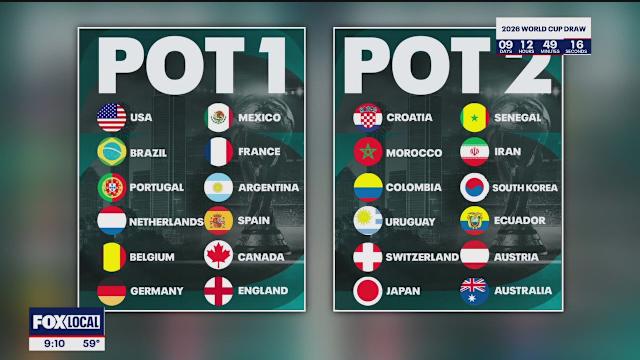
Confirmed 2026 World Cup draw pots
| port 1 | port 2 | pot 3 | pot 4 |
|---|---|---|---|
Canada | Croatia | Panama | Jordan |
Mexico | Morocco | Norway | Cape Verde |
United States | Colombia | Egypt | Ghana |
Spain | Uruguay | Algeria | Curacao |
Argentina | Switzerland | Scotland | Haiti |
France | Japan | Paraguay | New Zealand |
England | Senegal | Ivory Coast | Uefa Play-off A |
Portugal | Iran | Tunisia | Uefa Play-off B |
Brazil | South Korea | Uzbekistan | Uefa Play-off C |
Netherlands | Ecuador | Qatar | Uefa Play-off D |
Belgium | Austria | Saudi Arabia | Fifa Play-off 1 |
Germany | Australia | South Africa | Fifa Play-off 2 |
Conclusion
The World Cup draw pots and seeding system play a crucial role in shaping the tournament’s competitive balance. By grouping teams based on FIFA rankings, past performances, and confederation restrictions, the draw ensures fairness while also building anticipation and excitement among fans worldwide. Whether you’re following your national team or simply a football enthusiast, understanding how these pots and seedings work can significantly enhance the viewing experience.
They influence who faces whom in the group stage, determine potential knockout-path matchups, and can even affect a team’s journey toward lifting the trophy. While debates about fairness and transparency will always continue, one thing is certain the World Cup draw remains one of the most thrilling pre-tournament events in global sports.
FAQs
1. What are World Cup draw pots?
Draw pots are groups in which national teams are placed before the World Cup draw. They determine which teams can or cannot be placed in the same group.
2. How are the pots decided?
Pots are primarily based on FIFA World Rankings, although host nations automatically receive a top-seeded position.
3. Can two teams from the same continent be in the same group?
Generally no, except for European teams. UEFA can have up to two teams in the same group, while other confederations can only have one.
4. Why is seeding important in the World Cup?
Seeding prevents top-ranked teams from facing each other in the early stages, helping create balanced and exciting group matchups.
5. Does seeding guarantee an easier group?
Not always. A lower-ranked team with strong form or history can create a “group of death,” making the draw unpredictable.